Tuesday, June 4, 2024

Choosing an RV


I am not an expert on RVs or models, but I have bought 4 so far and this will be the 5th.   By now, I can map out the decisions you have to make as you adapt to the RV life, and likely you will need to do your own experimentation to find your perfect dream rig.


 Here are some of the decisions you will need to make.


What will you be doing in it?

Once a year vacations? Months long journeys? Parked in a resort park full time, or on your property? Traveling and living in it while working? Boondocking often or always full hookups?  Spur of the moment trips to see family? 


Each choice will lend itself to different RVs. Start with this question and develop your choices.


How long will you be living in it at a time? 

A few days to a few weeks for vacations: the smaller rigs will have usually have enough cubbies, cabinets and bins for those shorter trips. Inventory what you usually take on vacation, in suitcase size piles and compare to the number of storage spaces in the rig. When you’re camping for just a few days, amenities are less important, since you are outside much of the time. With that said, figure on rain at least half your camping days, so what ever you get will need to give you a comfortable shelter with enough space to keep you occupied. 


A month or longer: Bigger is better. Storage becomes crucial when you are full-timing or taking extended trips. Luxuries like washer/dryers can become necessities. Bigger fridges and more kitchen storage as well as wardrobe space are more important. A desk, or spacious dinette to accommodate work or crafts make it more like a home. If you are parking it full-time somewhere, you might want to look at destination, or park-model trailers, or even tiny homes. If the RV doesn’t have enough space for out of season clothes or boxes of photos or other items you can’t carry, you may need to keep a storage unit somewhere convenient.


What kind of RV?

Entry level choices for short term camping tend to be trailers or vans, pop-ups or truck slide-ins. Pop up trailer were out for me because they don’t feel safe for a solo woman. Truck campers and teardrops feel cramped to me, but if you rarely spend more than sleep-time inside, they could work for you. Vans are ideal for solo travelers and couples, as are the smaller class Cs, though elbow room can be tight.  The assumption here is you are bringing your bedroom and a kitchenette, but not a full house. The space under your awning outdoors is your living room and you will likely use the campground bath-house more often than your tiny bath facilities. 


Motorhomes and large trailers are the most like a house, with several seating and working areas, good if you are stuck inside because of weather. They will also have most of the amenities of home, including a respectable bathroom, much more closet space, washer/dryers and bigger aisles. 


Generally, if you plan to be on the road regularly, traveling to destinations or family, a motor home is the best choice. If you plan to park it at a resort or property for a few weeks or more, a trailer is the best. 


The best way to know which style of rv appeals to you is to walk through a lot of them at an RV show or dealer. Bring your travel mate and move around in them, seeing how you fit, what feels right. And, don’t worry, you will likely move up (or down) into another rv when you have had one for awhile. 


What Size?

Camping happens in everything from a converted station wagon to a 45 ft Peterbilt diesel pusher. It’s really the layout that counts, and what you need to fit into it.  But size comes into play in campground availability and cost. Rigs over 40 feet will have trouble finding spots in smaller campgrounds and are often not allowed in some state parks. 


Related to campground requirements is hookup availability.  If you will spend a lot of time in campgrounds, note that 30amp electric service is more common in the smaller rigs, while larger rigs require 50amp hookups for the larger electricity draw. Not all campgrounds offer 50amp service. 


Also, the larger, the heavier, the smaller mileage you will get from a gallon of fuel. This is true of both motorhomes and towing trailers. The cost of crossing the country in a large Rv, in fuel alone, will exceed the cost of flying in many cases. 


Boondoocking vs campgrounds?

Eventually, every rv trip will involve a night or two in a parking lot or side street where you couldn't arrange a campground stay. The more adventurous will see boon docking as a way of life, staying off-grid in federal and state lands and vacant fields to save on rv park fees. Most festivals require rvs to boondock in a parking lot or field, so I do have some BD experience, though lately we just stay at state parks. What you generally need from your rig is more: More battery power, more fresh water tank capacity, more black tank capacity, and more power regeneration capacity. That last item could involve solar panels and/or a generator. The bigger rigs generally have all those features, so if you plan to boondock regularly, a bigger rig makes more sense. 


Motorhomes: How much power?

There are a surprising number of Class Cs and As with 8 cylinder gas engines. I would not feel comfortable in mountainous areas with that small an engine. It might be fine for flatland trips to the beach. 10 cylinders is the standard for larger motorhomes. We are not looking to buy a diesel rig, but IMO, if it has a diesel, it will have enough power for the weight of the rig. 


Ready to go or fixer-upper?
Not everyone is up to the (sometimes years-long) job of renovating an old, beat-up rig. It has been three years our Airstream has sat in pieces on the driveway, but we had the room and the time during the pandemic to work on it. We bought the Coleman because we wanted to go camping right away. So assess your need to personalize and/or economize your rig versus your immediate need to just toss a bag of clothes in and go. 

There will always be some work all RVs need in maintenance, so getting to know the workings of an RV is worthwhile. Having access to a factory manual with parts listings and wiring diagrams makes that job easier. Some manufacturers (*cough* Dutchman) don't provide that information, so when fixing something, you are on your own - and on YouTube. But the support provided by a good manual can't be underestimated. 

Related is the accessibility of all the various utilities - you should be able to access the batteries, fresh water and hot water tanks, furnace, inverter, any pumps and hydraulics, etc. If any of these are behind a wall, with no access door, you won’t be able to fix that item yourself. Even if you take it to a dealer, it will cost more to get at and repair that system. 


Trailers: What kind of hitch, and what size tow vehicle?

The hidden cost of affordable trailers is that you need an appropriately powered tow vehicle to pull them, with the correct hitch. I have no experience with fifth wheel hitches, but my feeling is it will cost more than a ball hitch, will be more complicated to connect and will likely require a heavier truck. (Open to corrections on 5th wheel ease of use). But for both hitch styles, the larger the trailer, the heavier the tow vehicle. 


Regarding the power required, 4-6 cylinders is not enough to pull much other than a tear-drop or little ultra-light. 8 cylinders will be fine for most mid- size trailers. Anything larger than 38 ft will require a double axle and a bigger engine.  

Take a look at truck prices before you decide on the rv, it may force a rethink. And, if you will be parking it, you can hire a service to move it  once or twice a year, which may cost far less than owning a high-powered tow vehicle.


How many people (and furry people) will it need to hold? 

When I traveled on the festival circuit, I traveled alone and was a skinny young thing. A van fit me perfectly. Right now, my girl and I are seniors, and need our comfy spaces. We will be (eventually) adapting our three cats to the life, so where will they live? If you have them, kids and relatives will need extra bunks too. And think how everyone will fit on rainy days.


Will you need an extra vehicle? Do you need to tow it?

Trailers make it easy to unhook the truck to get into town or for sightseeing while the rv stays setup at the campground. Motorhomes are often too large for city streets and you have to redo your camp utilities setup every time you run out to the store. Bicycles or mopeds can sometimes suffice for short trips, but sometimes you need a street legal vehicle. Towing it adds cost, complexity, and setup time. There is the choice of flat-towing or using a dolly to consider. Or you could get a toy hauler with room for a small vehicle. And depending on your travel plans,  you might spend less by renting a car at your destination. Many questions to answer on this subject, one we are just beginning to address. 


New or used, and RV loans?

If you can buy through a dealer, you can usually finance it if you have good credit. They will have both new and used rigs and a large array of choices. RV loan payments can be very reasonable. This is how I bought my van, but I was working then. 


Now that I’m on a fixed income, I have no credit to get a loan, so I have bought my recent RVs with savings. If you can pay in cash, you can take advantage of the used market, which  is packed with all types of RVs. The manufacturers ramped up production during the pandemic and now there is a glut; even Camping World is auctioning off extra inventory. Prices are low, pop-ups and trailers going for less than 5k. You could buy a nice used trailer every year for 10-15K and never spend what a new one cost.  Even used Class As are reasonable right now. Start looking now!  I scour Craigslist and Rv Trader a couple times a week. 


Travel to your favorite model or Buy what is available nearby?

It can be expensive to fly to check out the exact rig you are dreaming of in person, new or used, but if you are committed to a certain model or layout, you will likely have that requirement. You will have to drive anyway if you are buying a trailer, so you have to figure what distance is doable for you. And remember, you might not like the Rv when you get there. So having a few possible favorites and keeping an eye on the local Craigslist board over time may get you most of what you want in an RV, if not your dream rig.  


Buy used from a dealer?

There are a fair number of big rv dealers around the country that carry used rigs that often are cleaned up if not refurbed, and usually will finance your purchase. It’s also not quite as interpersonal as meeting folks at their houses. Many people are more comfortable buying from a company. 


Depending on the location, you might get repairs done on your just purchased rig and even changes in features, costing extra, but saving a lot of time. Most will take  trade-ins too, saving money and time. 


You will develop a list of must-haves and absolute no’s after you have looked at a few models. 


A lot of your must-haves and never-haves will conflict, and you’ll have to prioritize the musts from the maybes. A lot will depend on your ability to make a decision, come up with the payment (or finance) and find a place for it to live while you adjust to a life-changing purchase.  If you are a first-timer, don’t worry, it gets easier each time. 


This won't cover every decision you will need to make, but it will get you started in the right direction. Want to know how we are deciding on our new rig? Click here for Travel Kat's answers to these questions. 


A final word: Give yourself plenty of time to look at different models. Don’t jump at the first one. Your ideas could change drastically. 


Have fun!


~~~~


Sunday, April 21, 2024

It's been a while.


May 2023, SC State Park
I started to write this post in January 2023, and here we are, over a year later. I think I ought to do an update.  

Like a lot of other Airstream renovators we followed, life inserted itself and the Planet Argosy project got bogged down. Our RV experiences became more active, once we had a working rig. We've been on at least one trip per year since we bought the Coleman and have managed to make it work, even for a 2 week trek to Florida to be a festival vendor. It will likely get spruced up and sold this year to make cash for an RV we can live aboard, more about that next post. 

The renovation has always been Lynn's project, but the conditions have never been favorable for her, and that was our main mistake. We were never able to find a way to raise up the carport to get the Argosy down the driveway to the relatively level concrete pad under the carport. We called carport dealers and handymen and no one wanted the job. So the trailer has been sitting on an incline, out in the elements with the demolition nearly done, but nothing can be built or fixed til it's level. Now, finally, we are developing a place to put it where we can get a proper space to work on it, but it will take some time to get everything in place. The Argosy has to be pulled together to be towed, so there's still work to do here too. 

And meanwhile, the plan of living full time in an RV is on the front burner. It won't be the Argosy, that is our main decision. A few years of once a year trips and already we know we need more space. So we're looking at motorhomes. That is what the next post is about, so I'll leave this here. The blog will be changing name as we shift to our general experiences in the RV realm and pick up coverage of the Argosy when we can get the right setup. I think it's all useful. Things change, and we change. Life changes. More to come. 


Thursday, January 27, 2022

Life slows down to a crawl... more than a year later

You will notice that last post was about fall 2020, but was posted this year, 2022. Somehow, 2021 disappeared without a trace. Yes, there was demolition work done on the Argosy, here and there, catchup posts to follow, but we are stuck in a way that only big changes can rectify, so we've been concentrating on the Coleman trailer, getting it set up and ready to travel. We've had one trip in it so far, our shakedown cruise, found many (many) issues with the utilities - after all, we did get a salvage title with it - but after a long visit to Gander RV in the worst of the RV craze, she is home and we are getting it ready for a March trip. 

It's not a bad little trailer, though compared to an Airstream, clunky and a little boring, but it's got a pretty good layout for a small trailer and it works for the time being. There is a huge advantage for us in delaying the Airstream renovations til we get a little more experience in trailer systems. Since my last two RVs were pretty much trouble free, I don't have as much familiarity with battery or propane problems, so we are getting an education trying to get our practice trailer, the Coleman, up to snuff. 

I'll post photos of our 2021 demolition soon. 

Still in demo mode, but we get distracted

October - December 2020


Here we are in December already and the demolition of the Argosy interior is still ongoing.

It's slow going because other things are coming up for Lynn with her work schedule, and me with house repair and renovations. We also had a huge amount of rain in September and that held everything up while we have no shelter.  A post on the Airforum.com site (an essential source for everything Airstream) reminded me that this process can't be rushed. 

This is a complex project, with lots of hurdles, and constant unpleasant surprises. Lots of skills needed, lots of tools needed, and time to research the best way to do something and then find what you need. The challenge is seductive, but the reality is, it's a bit of a slog. I have said it will take a year, but really, two is more realistic. 

We had hoped to go to the beach again this year, but with a new year zooming up on us, that is looking less and less likely. We imagined that by now, we might have the interior emptied out and painted, the frame, axles and wheels checked and secured, ready for a mattress and a cooler to be tossed in. Not even close. 

So, as the year closes out, it's all about demolition inside. 

And, this summer we got a "temporary" trailer, a little 21' Coleman to help us get through our renovation phase. So upcoming trips will be in the Coleman, and the Argosy will still b e there when we get back. 

Thursday, September 24, 2020

Breaking it all down - Demolition

July - September

Still no raising of the carport yet, but we moved the trailer back a few feet so the front to back tilt is not as extreme. Lynn began the demolition back in July, and is slowly breaking down the interior of the trailer. 

Before she started, we decided that while the original fixtures were all usable, and would work if we just freshened up and repaired this and that, we wanted to start from scratch. The quality of the Argosy interiors is definitely lower than the main line of trailers; the walls are basically vinyl-backed eighth-inch luan. I remember I had a nice birch plywood in my '69 Caravel, but these panels and cubbies are just not worth saving. 

We also looked at many photos of renovated Airstreams and noticed our favorites had all the storage at waist level, and not up crowding the view and blocking the light. The overhead cubbies had to go too.  For so many reasons, Argosies are the perfect trailer to go the renovation route, and not restoration. We're going after modern, bright, clean unobstructed lines. So everything will be pulled out, though we'll keep the inside skins to paint and rehang, after we check under the subfloor and re-insulate the shell. I started some drawings of a potential layout, but until the inside is stripped, those plans can wait. 

When we got it, the front dinette area was already gone, along with one of the skins. So that bit of demolition is done for us.


The refrigerator was also missing as well as most of the lower cabinet that held it. That bit was easily pulled out but it left the vent from the propane system along the wall and inside the cabinet. 

Once that was pulled out, a long stripe of old vent-dirt was left. Surprisingly, it washes off pretty easily. The skin is probably just fine to paint. There's a bunch of propane pipe and electrical that went to the refrigerator that will likely get removed, but we're keeping it for the time being. 


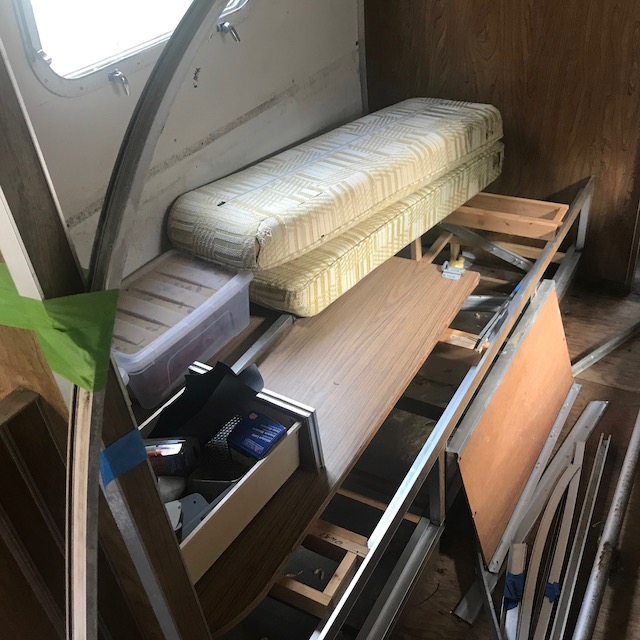
Once the cubby and  partition just next to the door was pulled, that left the bed frame to pull out. The structure is just 2x2's and knocked together, so easily pulled. Not sure what the massive amount of spray foam was about, nor what the reflective insulation was for, to block road noise or exhaust from the tow vehicle maybe? 


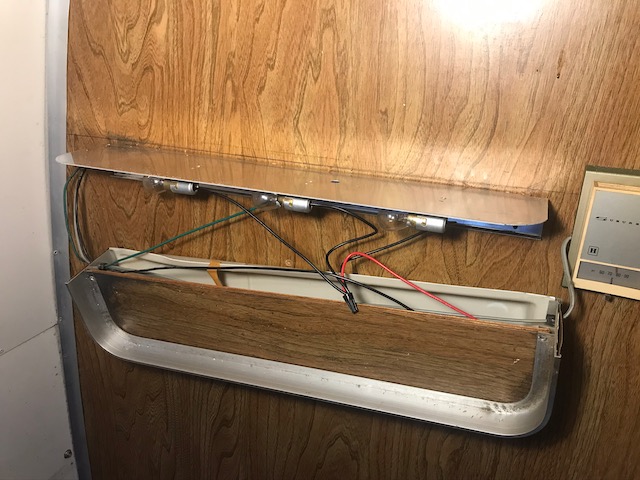
Next along the left (door) side moving back is the bed light on the bath partition, really a nice vintage design, and we will keep them to paint and re-use. Lynn shot these photos to remember how they were wired, along with the thermostat, which is probably toast


Now the partition, left side is gone, opening up the bathroom to view.


Now the shower pan has to come out, and while there's a bit of water damage, it doesn't look  extensive, but... there's a patch. ok, for future reference.  


The mirror above the sink is a really nice feature. We'll likely keep it.
That's it for this post. More photos to come.


Friday, August 28, 2020

Update on demolition


July 10 (from Lynn)
Not a lot to report.  The heat here in the Carolinas has been bearing down. I thought we found a contractor- to raise our carport-turns out he only played that role- he gave an estimate to raise the carport rails. We lined him up 3 times and 3 times he didn’t show or even  call. So, we’re still looking for someone to raise our metal carport. 

I began removing the bunk beds, cabinets, pulled out the fresh water tank. We need to see the frame and inspect that. Our goal is to make sure that the frame is road worthy. That’s at the top of our list.


Raising the carport will obviously give us some much needed shade. The humidity this past week was brutal.  Difficult to wear a mask while working inside. 


More photos before we start

5/1/20
These were taken as we went through the trailer looking to establish the good and the bad.

Our manufacturer's plate. It's a 73, officially but it was dated 11/72 on this plate.


The steel endcaps on both side are badly rusted. There's also a lot of hinky paintwork in several stages of breakdown. Hopefully the rust can be sanded/ground off and sealed and painted smoothly


(Below) This seems to be the original setup of the black water tank outlet. It's located in the back, in the center under the fairly wide bumper. In other words, you have to get down on your hands and knees and reach in about 18" to hook up your hose. That is really unacceptable. I remember the '69 Caravel had an outlet to the side, easily accessible. 

(Below) I don't know what to make of this. This looks like the grey water outlet, but I'm not sure, the water system is not hooked up and no demolition has been done yet. There looks like there were rivet holes once, but now it's just a jagged mess.

(Below) This is the compartment for the battery, you can see the subfloor has been damaged, probably eaten through, since there is evidence of several nests in the back. Yuck.


The back bumper/compartment is badly rusted at both ends, not sure yet if it's bad enough to replace.


Now for some inside notes. Along with the demolition at the front, where the couch/gaucho was pulled out, the refrigerator and some of the cabinet just inside the door are also missing. All of the rest of the  kitchen is intact, though in questionable shape. The stove is rusted but probably works. The sink is fine, but so shallow, we will probably replace it. On the positive side, all of the windows and hardware are intact and working great! Just missing one screen, and all the weatherstripping needs replacing, but glad we don't have to replace anything major there. 


A view to the bedroom and bath, as it was packed up at the previous owners. Those long pieces are the protective rubrails for the outside, that protect the seam around the mid-section. There's some other miscellaneous hardware we're not sure of. We got the front gaucho cushions, but they are nasty and will def be thrown out.   

More bins of stuff, and the table top that goes with the front couch. You can see the bed structure underneath, all intact.


The bathroom is mostly intact, no photos yet, but the nice pocket door is still there. Too bad we will probably be tossing that too.


These next photos below were taken a bit later, as we started to look more closely and take off some of the tape. Yes, the cold hard look. 
First, note that the carport is way too short, as we found out on pick-up night. We've had some issues with that, more on that later. 
Just to document the problems from one view:
  • Badly rusted steel caps
  • Shoddy installation of ceiling vent fan (rear), taped-in, because the corners hadn't been cut and the facing didn't fit. We did get the remaining parts and docs for the fan. 
  • One ceiling fan with fan removed and only cap and brace still there
  • Hard to see from here, but there's a round vent on the far side opposite the door, that has paper and plastic taped over it. No idea if there should be a cowl over that. 
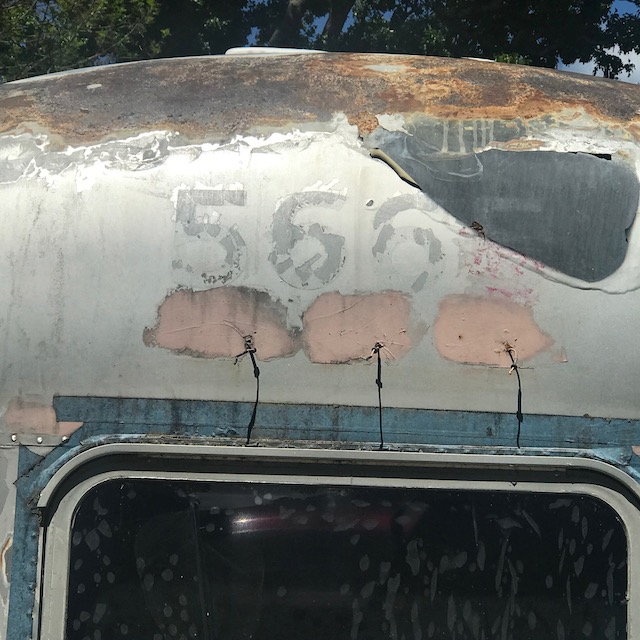
  • ALL of the running lights and outdoor house lights have been removed, with just the pigtails sticking out and bondo covering the spot.  We got the fixtures in one of the bins, we think all are accounted for. 
  • No lock on the door; it's completely gone. 
  • There is tape everywhere, hiding many sins, we are sure. See below.

(Below) the tape over the center front window hides a row of pitted rust. This is the front steel cap, remember. Note the front coach light pigtails. It's not rusted through, but we don't know if it's sound.  Note some evidence that the top has been painted dark red and yellow previously. 


(Below) We didn't notice this at all when it was covered in dirt, but it looks like someone went wild with his grinder, and didn't clean up afterwards. Luckily, it's not deep. This is an aluminum panel (just below and to the side of window under the front end cap) Since we know we will paint (seal that steel!) we know this can be bondo'd and painted.


Finally, (not really, more to come) this is a mess and we barely have begun to remove the tape. The compartment goes inside to a cabinet, so outdoor storage. I guess the latch is broken and the plate for the electric outlet next to it is gone. Also, one side of the step ladder has broken off. The other side is holding for now, but we really need to fix that soon, it lists to the side.

The tick list has begun.